

Overview
Department of Social System Design
What is Social System Design?
A methodology for identifying questions within society and independently exploring solutions—aimed at solving complex social challenges and creating new value.
2025.11.20s.jpg)
System thinking × Design thinking → Innovation
- System Thinking
Ability to “look at the forest and the trees at the same time”
Ability to value the individual while simultaneously creating something beautiful
Having Both a Bird’s-Eye View and a Worm’s-Eye View
- Design thinking
Ability to plan your desired future
Practical execution skills
Designing your own vision for the future
Message from the Dean
Let’s Create the Future Together
What kind of future do you want to create?
prepares for us. It is something we create ourselves — by asking questions, acting, and collaborating with others. At the Faculty of Social System Design at Eikei University of Hiroshima, we are serious about that challenge.
Today’s society faces many complex I ssues without simple answers: environmental problems, population decline, regional decline, food
loss, plastic waste, and multicultural coexis – tence, to name just a few. In such an age, what matters is not simply the ability to memorize knowledge. We need the ability to identify problems, work with diverse people, develop new solutions, and persevere until challenges are overcome.
At Eikei University of Hiroshima, we place strong emphasis on five competencies: Global Collaboration, Foresight, Strategy, Energetic Drive, and Self-improvement. Our goal is to nurture individuals who can understand social change, discover essential issues, collaborate with people from diverse backgrounds, and create new social values.
For this reason, we emphasize active learning in every course. Rather than relying solely on one-way lectures, students learn through dialogue, group work, fieldwork, and presentations.
In addition, through Project-Based Learning (PBL) courses and domestic and international Experiential/Practical Programs, students work together with companies, government agencies, NGOs, NPOs, and international organizations to tackle real-world social challenges.
Throughout my career, I have conducted research to address social issues such as environmental problems, food loss, and plastic waste.
Through these experiences, I have strongly come to believe that it is people who take on challenges who change society. At Eikei University, students gather with a genuine desire to shape a better future.
Why not begin your own challenge to build a new society with others who aspire to create the future?
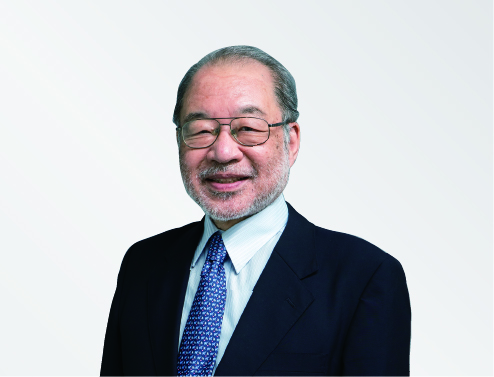
ISHIKAWA Masanobu
Vice-president / Dean / Specially Appointed Professor
Ph.D. in Engineering, Department of Chemical Engineering, Graduate School of Engineering, The University of Tokyo He previously served as an associate professor at Tokyo University of Fisheries and as a professor at the Graduate School of Economics, Kobe Universi-ty. He was appointed as a specially appointed professor at Eikei University of Hiroshima in . His academic field is Environmental Economics, and he is a professor emeritus at Kobe University. In , he established the NPO Gomi Japan. He has served on various government advisory councils, including the Ministry of the Environ-ment, the Ministry of Economy, Trade and Industry, the Ministry of Agriculture, Forestry and Fisheries, and the Consumer Affairs Agency. His main research areas include plastic waste and food loss issues.
EUH’s 4 Features

Five Competencies
You will develop the five essential competencies needed to create new value in society and become a person who can envision and create shared futures.

English for Diversity
You will acquire practical English skills and become a person who understands diverse perspectives.

Collaboration with Society
You will have extensive real-world experiences both inside and outside the class—gaining insights into society, building experience, and connecting with people.

Support for Quests
You can freely explore and address social issues that interest you, with support to help you unlock your full potential.