SDGs-oriented liberal arts(General Courses
Acquire the cultural skills to navigate global society
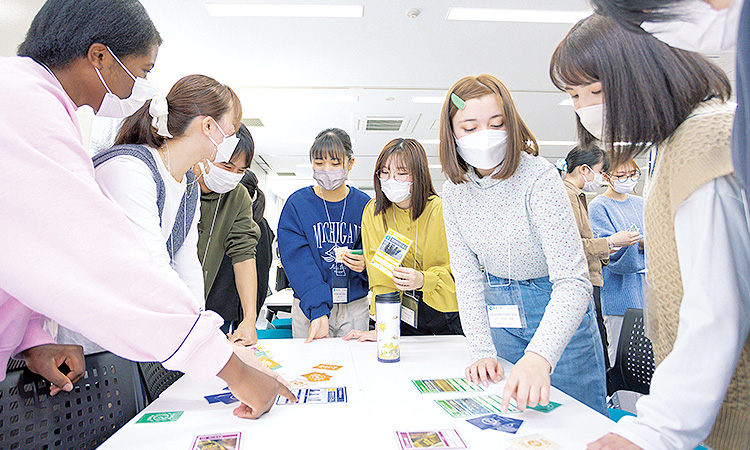
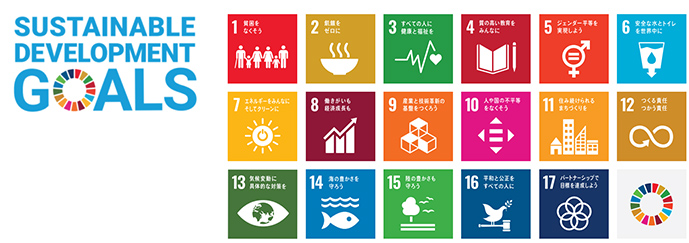
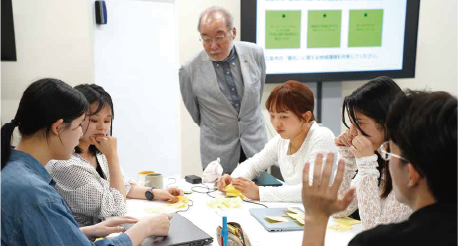
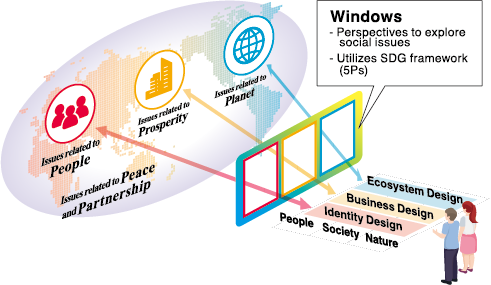
At Eikei University of Hiroshima, students acquire the knowledge and methodological approaches necessary to understand the numerous challenges facing modern society through a liberal arts education and develop the competencies of foresight and self-improvement. The liberal arts courses at Eikei University of Hiroshima are designed with a focus on the SDGs (UN-adopted international goals for sustainable development), which serve as a central framework for learning.The 17 SDGs have been grouped by the UN into five categories, known as the 5Ps (Peace, Partnership, People, Prosperity, and Planet). Students choose one or more of these “windows” based on their interests, and use them as perspectives to explore social issues and gain useful knowledge. (Main academic fields: humanities (art and literature, philosophy and ethics, psychology, and cultural anthropology), economics (business administration), and environmental studies in the natural sciences)
Pillars for learning: 5Ps
Fundamental courses
Fundamental courses are categorized into Peace and Partnership in these 5Ps as required subjects for all students.
| 5Ps | Knowledge to be acquired |
| Peace | Standards to be referred to when solving problems such as building a peaceful society or collaborating with diverse stakeholders |
| Partnership |
Advanced courses
Advanced courses are categorized into the 3 perspectives (People, Prosperity, and Planet) and are to be selected as electives according to the students’ interests.
| 5Ps | Perspectives | Knowledge to be acquired | Academic fields |
| People | Identity Design | Thinking frameworks to figure out social issues and respect diversities in multicultural societies | Humanities |
| Prosperity | Business Design | Structure of a globalizing economy and society, and industrial / technological development | Economics |
| Planet | Ecosystem Design | Awareness of environmental conservation and biodiversity towards development in coexistence with nature | Natural Science (Environmental studies) |
<Image of the “Perspectives”>
Class Focus: Examples of Courses in Each Window
Identity Design “Studies in Diversity and Multiculturalism”
In today’s society, where globalization and changing demography pose various challenges, it is essential to create a society in which people of all diversity can live safely and play active roles regardless of nationality, gender, age, sexual orien-tation, disability, faith, etc. In this course, students will understand existing diversities of individuals and com-munities (groups of parties), as well as how diversity can be socially constructed. Students will also consider what challenges these diversities may cause in modern society and can be a clue to solving them. The purpose of this course is to obtain the perspective and basic knowledge necessary for the formation of an inclusive, multicultural society.

Business Design “Management Strategy and Organization Theory”
As social issues become increasingly diverse and complex, often crossing institu-tional boundaries, the need for both companies and nonprofit organizations to play a significant role has grown. In this course, students will learn the fundamen-tal concepts and theories of management, including “formulating strategy,” “building organizations,” and “motivating people.” They will also deepen their understanding of strategic management that links social impact with business viability. By applying this knowledge, students will develop strategies for building more sustainable organizations.
経営戦略・組織論-1024x683.jpg)
Ecosystem Design “Environmental Economics”
In this course, students will learn the fundamentals of a framework for analyzing, from an economic perspective, the mechanisms behind environmental problems and how to address them. Students will gain an understanding of the concept of public goods and recognize that environmental problems stem from the fact that the value of the environment—as a public good—cannot be assessed in the market. Additionally, students will learn about the characteristics of various policy tools for addressing environmental problems, such as environmental taxes, emissions trading, aggregate emission controls, and voluntary agreements.