

Competency refers to the ability to apply the knowledge and skills acquired in one’s field of specialization across a variety of domains and situations.
To realize a better society, it is essential for people, universities, society, and the environment to interact with one another and evolve through those interactions.
To enable this interaction, that means the mutual transformation, it is important for all of us to develop competencies that allow individuals to learn and act collaboratively beyond personal and institutional boundaries, in addition to the knowledge and skills specific to individual academic disciplines that are emphasized in traditional higher education.
Students at Eikei University of Hiroshima aim to acquire these five competencies—Global Collaboration, Foresight, Strategy, Energetic drive, and Self-improvement—through active learning by the time of graduation. These five competencies are cultivated holistically through EUH’s curriculum built on repeating cycles of “academic input” and “practical output.”
Grounded in this educational philosophy, we conduct competency assessments, —not only through numerical grading, but also by using the Eikei University Standard Competency Rubric (including students’ self-assessments). Degrees are awarded to students who have developed the foundational abilities to shape how society works for the better, or what we call “social system design.”
Competency Development Center (CDeC)
To support students in effectively developing their competencies throughout their journey from enrollment to graduation, we have established the Competency Development Center (CDeC). The Center takes a comprehensive approach, encompassing curriculum and course improvement as well as career guidance and support.
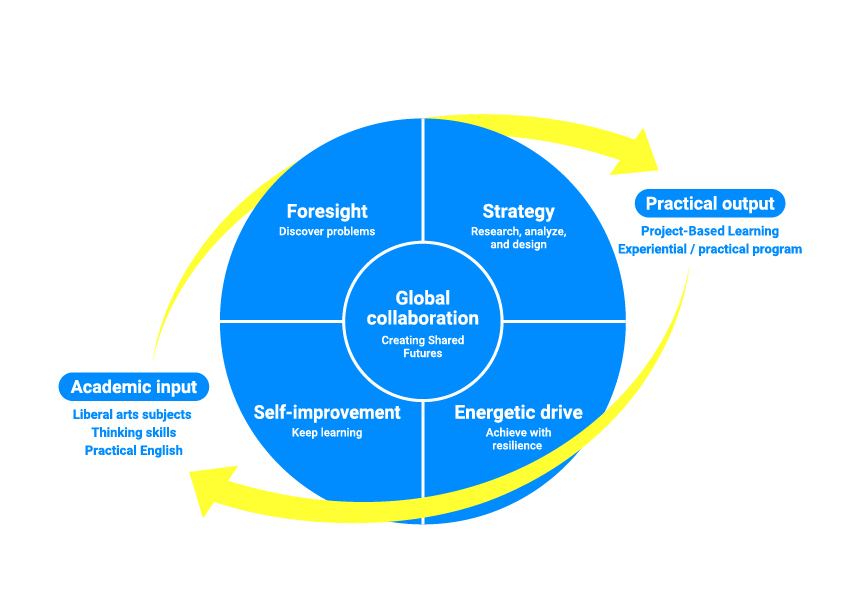
| Global collaboration Create shared futures | Global civic engagement based on diversity Civic engagement is action toward achieving a better society and toward developing knowledge, skills, and values that make such action possible. In today’s globalized society, global and inclusive civic solidarity beyond state-based “international” collaboration is required. We nurture global citizenship that respects and collaborates with various diversities, including nationality, origin, language, gender, sexuality, and bodies. |
| Foresight Discover problems | Insights based on critical exploration Being critical means forming one’s ideas after exploring things comprehensively from multiple perspectives. We cultivate insight and foresight by fostering abilities to discover problems and explore them based on liberal arts education. |
| Strategy Research, analyze, and design | Problem-solving based on analytical investigation Problem-solving is the process of designing, trying out, and evaluating an overarching strategy to engage with an open-ended question or to achieve a goal. We instill the ability to plan flexibly to deal with uncertain or unexpected situations, based on research and analysis. |
| Energetic drive Achieve with resilience | Striving based on mutual autonomy Executing a project to solve a problem requires teamwork that respects and promotes the autonomy of everyone involved. We promote four interrelated abilities: to create spaces where team members can engage constructively, to communicate effectively while maintaining mutual autonomy, to respond flexibly to difficulties, and to steadily carry out plans with others. |
| Self-improvement Keep learning | Exploring based on curiosity and reflection Exploring refers to continuous learning beyond the framework of educational institutions to improve one’s knowledge, skills, and abilities. Exploring requires curiosity and the ability to reflect on previous learning as well as to connect and transfer it to other situations. We foster the ability to improve oneself by continuing to learn. |