
About
Alumni

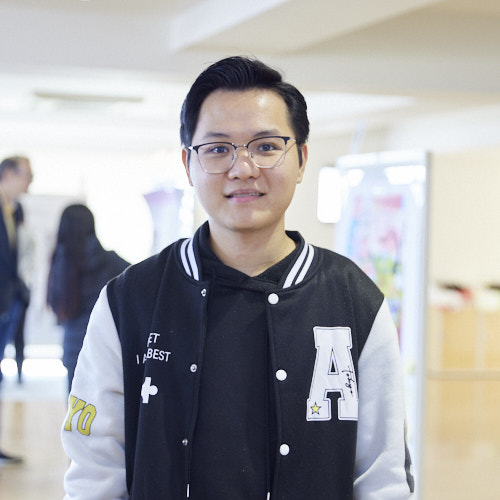
TRAN Minh Sang
March 2026 Graduation
Updated March 2026
Crossing Borders to Become a Bridge Between Vietnam, Japan, and the Western World
Beyond Disciplinary Boundaries
Before entering Eikei University of Hiroshima, I admired CEOs like Elon Musk who led multiple industries, and I held a vague dream of “one day becoming someone who can bring positive change to society in Vietnam and Japan.”
I was interested in so many fields—economics, environmental issues, ICT, data science, and English—that even my language schoolteachers were a bit surprised. But pursuing all of these interests at a traditional university would have been nearly impossible.
That was when I discovered Eikei University of Hiroshima.
I realized that the university offered exactly the kind of learning environment I had been searching for: a unique curriculum that aligned perfectly with my ideal academic and career path.
Once I found that everything I wanted to learn existed in one place, the decision to enroll became effortless.
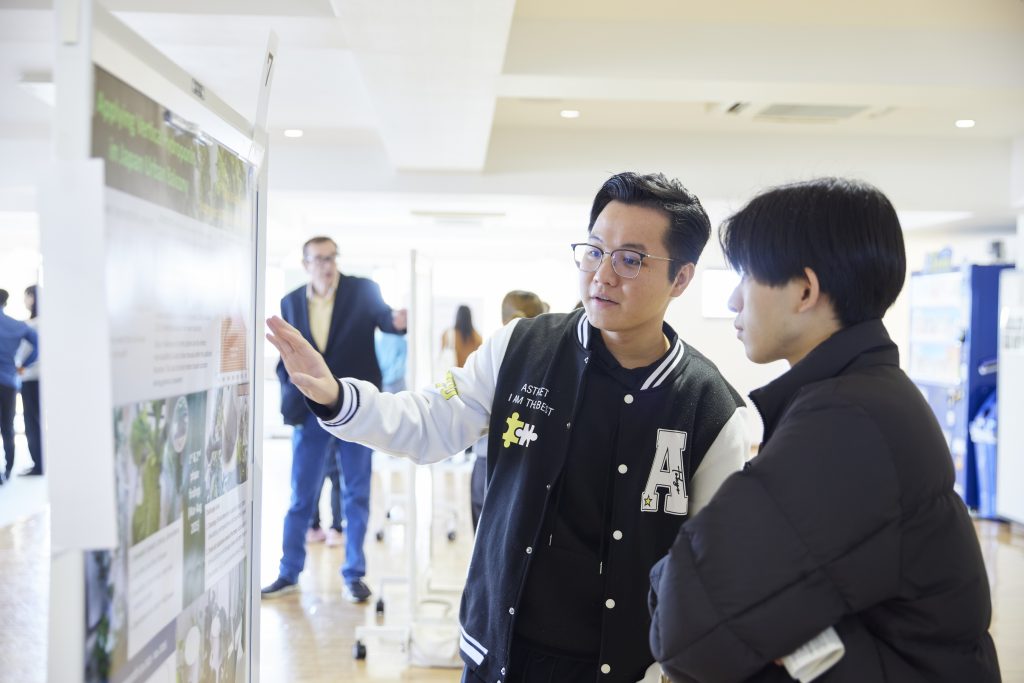
Liberal Arts Provided the Foundation for Thinking Deeply
The Liberal arts subjects I took during my first and second years—such as economics, environmental studies, history, and the ethics of science and technology—became the foundation of my academic learning. Until then, I had only understood social structures and events on a surface level, but these courses gave me a compass for gaining deeper insight.
In my later years, the cultural anthropology courses left a particularly strong impression. By analyzing the backgrounds and underlying contexts of topics that are not often highlighted—such as violence, religion, and cultural practices—I developed the ability to view issues from multiple perspectives.
Before, I tended to assume that “there is only one correct answer,” but as I encountered diverse philosophies and ways of thinking, I gradually stopped evaluating everything through a simple “right or wrong” lens. I feel that I have developed Foresight—the ability to see issues from various angles and identify the essence of challenges that have not yet surfaced.
From “Someone Who Cannot Speak English” to “Someone Who Learns in English”
When I was in elementary school, English felt completely out of reach—something I didn’t know how to approach and could never imagine doing. Until entering Eikei University of Hiroshima, I had almost no opportunities to use English in daily life.
However, through six months in the Intensive English Program (IEP), I rebuilt my foundation from scratch. From that point on, for all four years, I continued to challenge myself to learn in English every day and speak in English regularly.
My expressions may still be simple at times, but now I can confidently use English at a level fully suitable for academic classes. Through this experience, I learned firsthand the importance of growing continuously rather than becoming comfortable with the status quo. This growth is truly a result of the Self‑improvement I cultivated over the years.
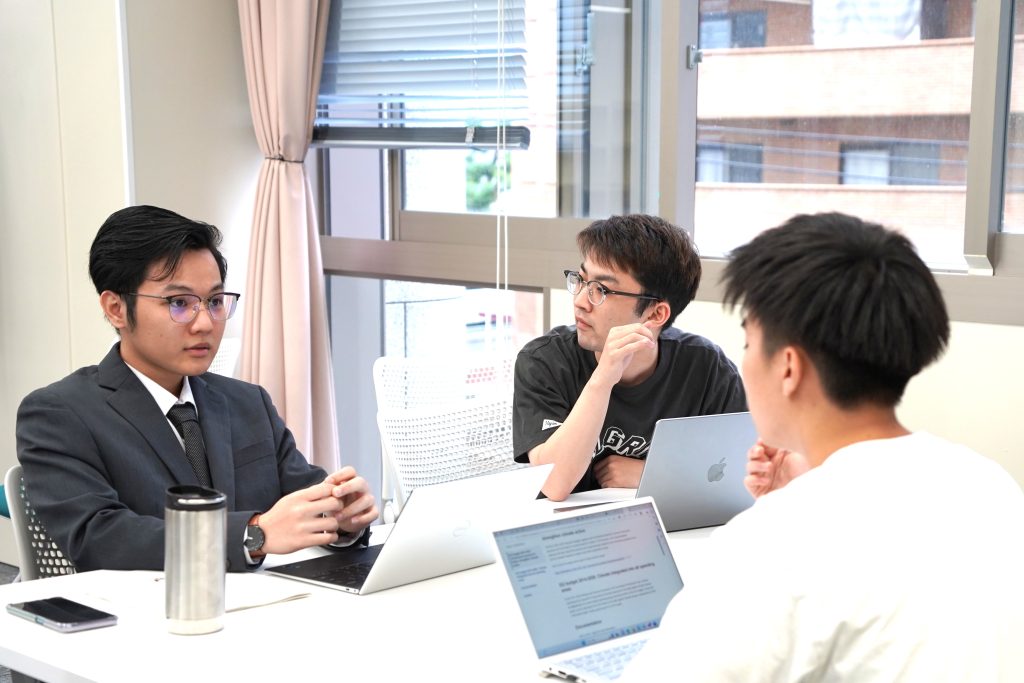
What Project-Based Learning (PBL) and Collaboration Taught Me
Through Project-Based Learning (PBL), I gained a deep understanding of problem‑solving processes and collaborative work with stakeholders. In addition, the Facilitation course and my experience as a Student Assistant (SA) provided excellent opportunities to learn how to lead group work with peers from diverse backgrounds and how to create an inclusive environment where everyone feels comfortable participating.
By engaging in dialogue with students who hold various values, I developed strong Global collaboration—one of the five competencies emphasized at Eikei University of Hiroshima. Working together across differences in language and culture taught me not to cling to a single “correct answer,” but instead to integrate multiple perspectives and move forward collectively.
Aiming to Become Someone Who Drives Social Change
After graduation, I hope to address the social issues I have engaged with so far by applying the multi‑perspective approach I developed at Eikei University of Hiroshima. My goal is to promote technological innovation at an international company and serve as a bridge connecting Vietnam, Japan, and Western countries.
At the same time, I want to contribute to solving Japan’s pressing challenges—such as declining agricultural self‑sufficiency, rising food prices, and demographic shifts. Through my balcony hydroponics project, I hope to offer people living in urban areas new perspectives and new options for engaging with food and agriculture.
The dream that once felt vague has gradually transformed into concrete actions through my learning at Eikei University of Hiroshima.
Over these four years, my worldview expanded significantly, and I learned to shape my own ideas in my own words. This ability is one of the greatest assets I gained from my time at the university.
Carrying with me the multi‑layered perspectives and the commitment to building trust through dialogue, I hope to contribute to society on a global stage in the years ahead.
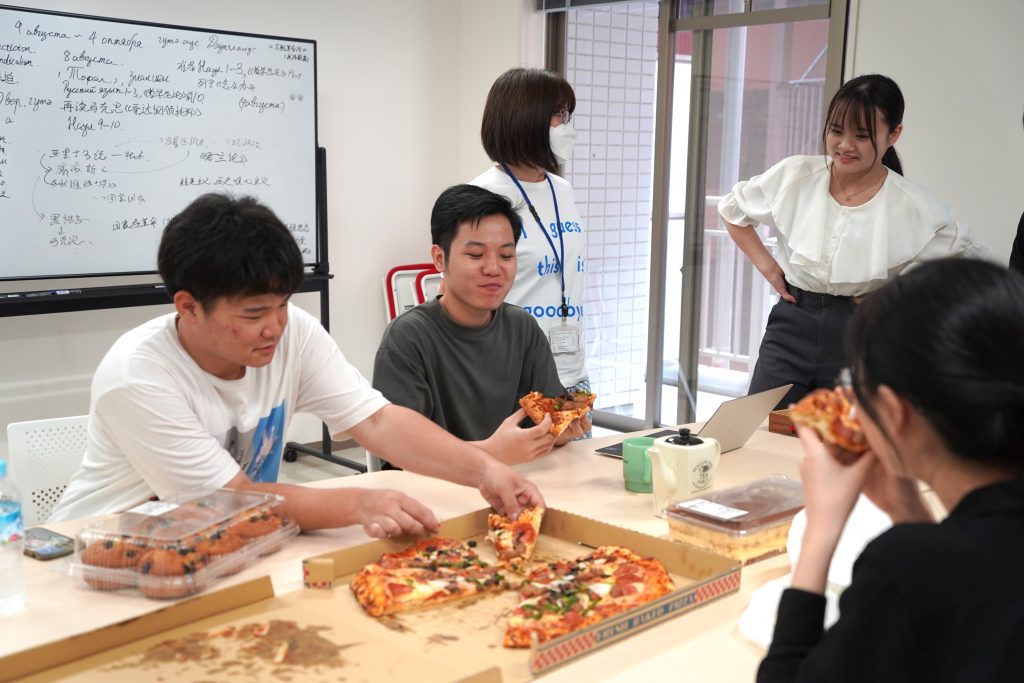
Message to Prospective Students and Juniors
I especially encourage students who feel uncertain about their English proficiency to experience the Intensive English Program (IEP) at Eikei University of Hiroshima. If you devote the first year after enrollment to studying and practicing English with full commitment, you will undoubtedly feel significant growth—and your university life will become much more enjoyable. At Eikei University of Hiroshima, Japanese students are required to take 64 credits of English courses, and the campus is home to many students from around the world, creating an environment where learning and interacting in English happen naturally.
Another important point I want to share is that Eikei University of Hiroshima brings together students with truly diverse backgrounds. Through four years of learning, you will gain a wide range of perspectives and ways of thinking, and your worldview will expand dramatically. While Japanese culture tends to be calm and modest, many places in the world expect active discussion and open competition. Understanding, accepting, and adapting to these differences is, in my view, an essential step toward becoming a global student at Eikei University of Hiroshima.
TRAN Minh Sang – EIKEI UNIVERSITY OF HIROSHIMA(Japan)
【Message from a current student】TRAN Minh Sang – EIKEI UNIVERSITY OF HIROSHIMA(Japan)
[Degree Project] Public Presentation and Poster Presentation – EIKEI UNIVERSITY OF HIROSHIMA(Japan)