
About
Alumni

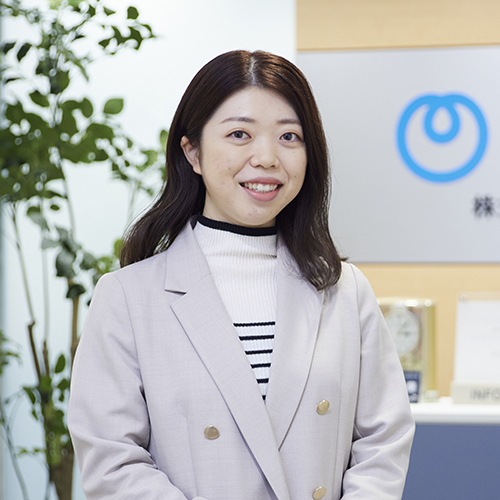
OKUBO Honoka
NTT DATA CHUGOKU Corporation March 2025 Graduation
Updated January 2026
A student who once lacked clear goals grew tremendously by taking initiative—an Eikei University of Hiroshima pioneer in IT infrastructure shares why “how you learn” matters most.
Eikei University of Hiroshima, established in April 2021, adopts a curriculum that combines “acquisition” and “practice.” Students develop competencies defined in the Diploma Policy through repeated cycles of acquiring knowledge and skills—via Liberal arts subjects, Basic tools subjects, and Practical English—and applying them in Project-Based Learning (PBL) and Experiential and Practical Programs.
One of the most distinctive features is the Degree Project, the culmination of four years of learning. Students set their own themes, clarify issues, and propose solutions, presenting their outcomes in a final public presentation. Faculty members act as mentors, but students lead the process.
Another requirement is participation in Experiential and Practical Programs, including overseas activities such as internships, volunteer work, or short-term study abroad during the second or third year. For many first graduates in March 2025, this experience became a turning point.
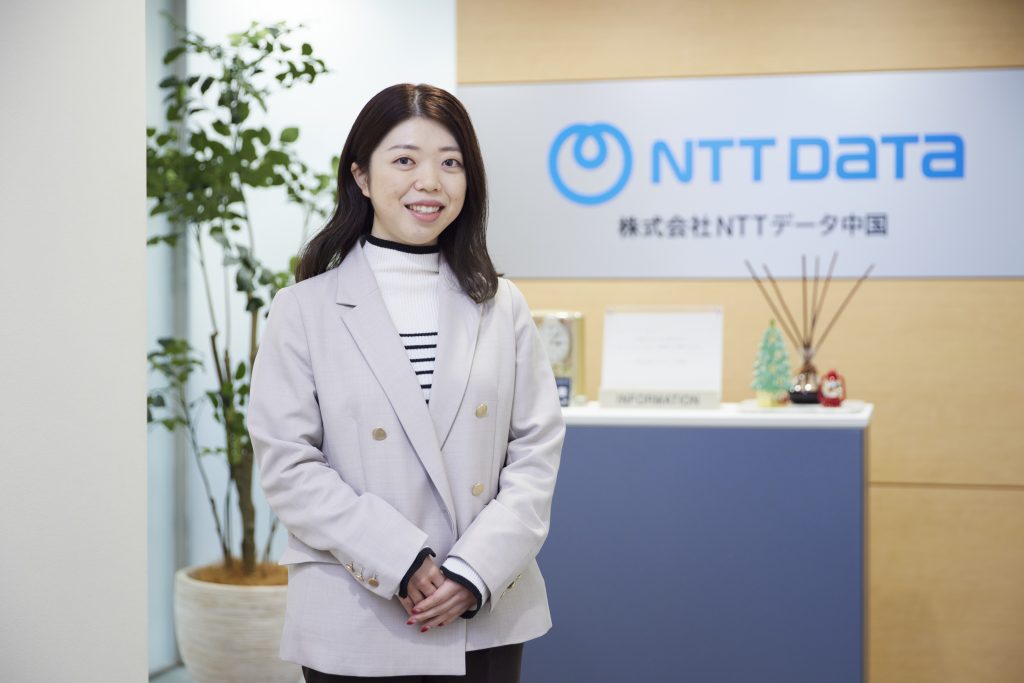
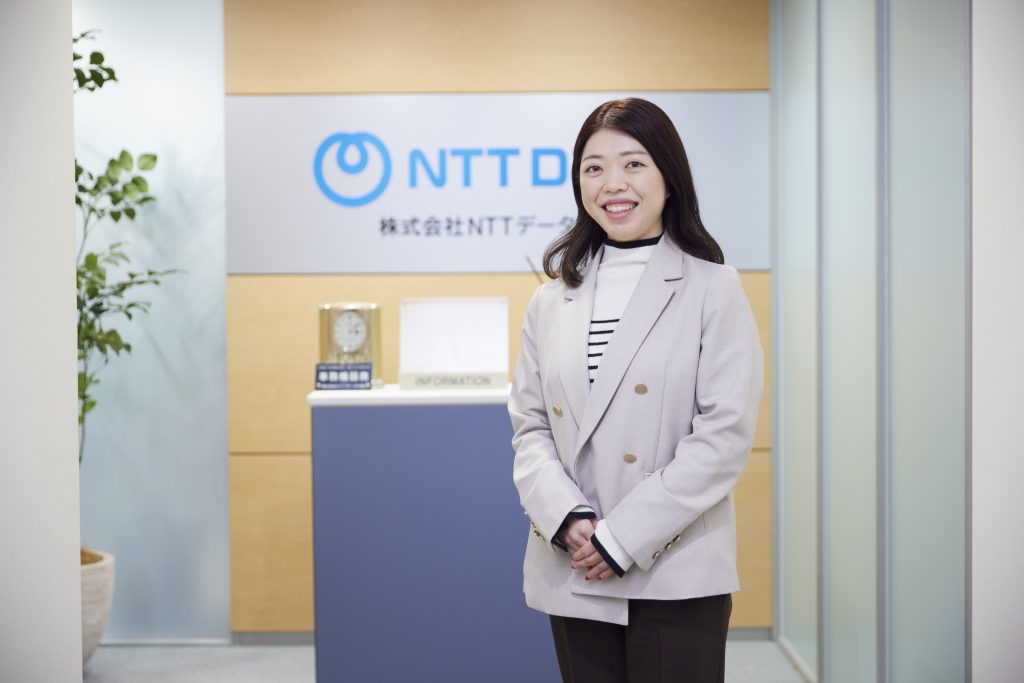
OKUBO Honoka, now working on IT infrastructure at NTT DATA CHUGOKU Corporation, is one of them. Initially unsure of her goals, she shares how she learned and grew at Eikei University of Hiroshima.
Take Every Class That Looks Interesting
—When you entered university, you didn’t have a clear idea of what you wanted to do, right?
I didn’t have a specific field I wanted to study or a particular career in mind. That’s why I chose Eikei University of Hiroshima, where I could learn broadly across disciplines. Even though I wasn’t sure what I wanted to do, I had a strong desire to take action. I wanted to challenge myself in various ways and clarify my interests.
What made a big difference was being part of the first cohort, surrounded by proactive students. By getting involved in and even being pulled into student-led projects, I naturally started thinking and acting more actively—asking myself, What if we try this? For example, when friends organized inter-year exchange events, I contributed ideas, and they refined them. We inspired each other to find better solutions.
—Did you also take an active approach to your studies?
Yes. I tried to enroll in every class that looked interesting. As a result, I found myself focusing on Basic tools subjects like ICT and Data Science, and Liberal arts subjects such as Business Design. That’s when I realized where my true interests lie.

Learning through the PDCA cycle
—What was the biggest turning point during your time at university?
It was the overseas program I joined in the summer of my third year as part of the Experiential and Practical Programs. Although the university offered programs, I wanted to plan and execute everything on my own, so I chose an independent program.
The program took place in Vancouver, Canada, a multicultural country. I volunteered at a local community center, working with preschool children.
—Were you already interested in children or child support?
I started working part-time at an after-school daycare in Japan because a friend invited me. Before that, I never thought I was interested in children, but through that experience, I discovered their charm and my interest grew.
In Canada, at first, I lacked confidence in my English and didn’t know how to communicate. To improve, I kept a weekly journal to reflect on my actions and set goals for the next week—applying the PDCA cycle. For example, I learned that approaches to children differ between Japan and Canada. In Japan, group activities are common, while in Canada, children’s choices are prioritized. Understanding these cultural differences changed even the way I spoke to them—from saying “Let’s do this” to asking “What would you like to do?”

Shaping Issues Through Affinity Diagrams and Fieldwork
—Your Degree Project also focused on children, didn’t it?
Yes, I chose developmental support as my theme. I started by asking myself, How can we improve the quality of developmental support? I reviewed literature, extracted frequently used keywords and common scenarios, and organized them into an affinity diagram. I created a category called “human interaction,” grouping children, parents, and caregivers. Through this process, I realized that supporting caregivers could lead to better quality overall. This approach to learning was something I had practiced in Project-Based Learning (PBL).
I also conducted field interviews with staff members. My professors advised me on how to frame questions. For example, instead of asking, What tools do you need now? I asked, What’s the hardest part of your work? Or even, If you could have a gadget from Doraemon, what would it be? By varying the questions, I was able to uncover deeper insights.
—What issues emerged from the affinity diagram and interviews?
I found that caregivers spent a significant amount of time on administrative tasks. Reducing this burden would allow them to spend more time with children, ultimately improving the quality of support.
There were two major tasks causing the burden. As a solution, I applied what I learned in application development classes and created an app to streamline these processes. The tool digitizes tasks that were previously paper-based and uses templates to simplify document creation. My four years of IT learning became a major strength in this final project.
“How You Learn” Matters More Than “What You Learn”
—Your four years at university also strengthened your IT skills. Is that why you chose the IT field?
Yes. More precisely, it was because I wanted to make an impact on many people. Through classes and my Degree Project, I experienced app development and realized how powerful its influence can be. IT—and further, digital transformation—has the potential to fundamentally change entire industries and society itself. I wanted to be part of that.
—Are the skills you gained at university useful in your work now?
Absolutely. Competencies such as Strategy, the ability to organize information and shape social issues, and Energetic drive, the persistence to keep trying without giving up, are invaluable in my job. Recently, I’ve been involved in upstream processes like design and planning. It’s challenging at times, but by incorporating feedback from senior colleagues and supervisors, I strive to create better solutions.
Looking back, I believe what matters most at university is not “what you learn” but “how you learn.” Once you master approaches like problem-solving and the PDCA cycle, you can apply them in any field after graduation. At Eikei University of Hiroshima, I learned exactly that—how to learn.
■Comment from a supervisor at NTT DATA CHUGOKU Corporation
Learning at work should not mean simply accepting training programs as they are, but rather thinking about what you want to achieve, envisioning who you want to become, and planning the steps to get there.
Experiences such as interacting with different cultures and engaging with children—and the competencies developed through those experiences—are clearly reflected in this proactive approach to learning.
Through daily experiences that differ from student life, I expect steady skill development and growth into a professional who can create IT systems that truly empathize with the needs of their users.