
About
Alumni

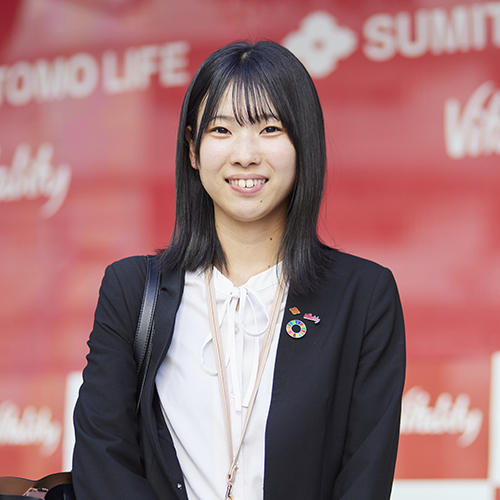
KAKUMORI Tomomi
Sumitomo Life Insurance Co., Ltd. March 2025 Graduation
Updated January 2026
Dialogue and Co-Creation: Opening the Path to Well-Being!
Outstanding Communication Skills of an Eikei University of Hiroshima First Cohort Graduate Surprising Senior Colleagues in the Insurance Industry
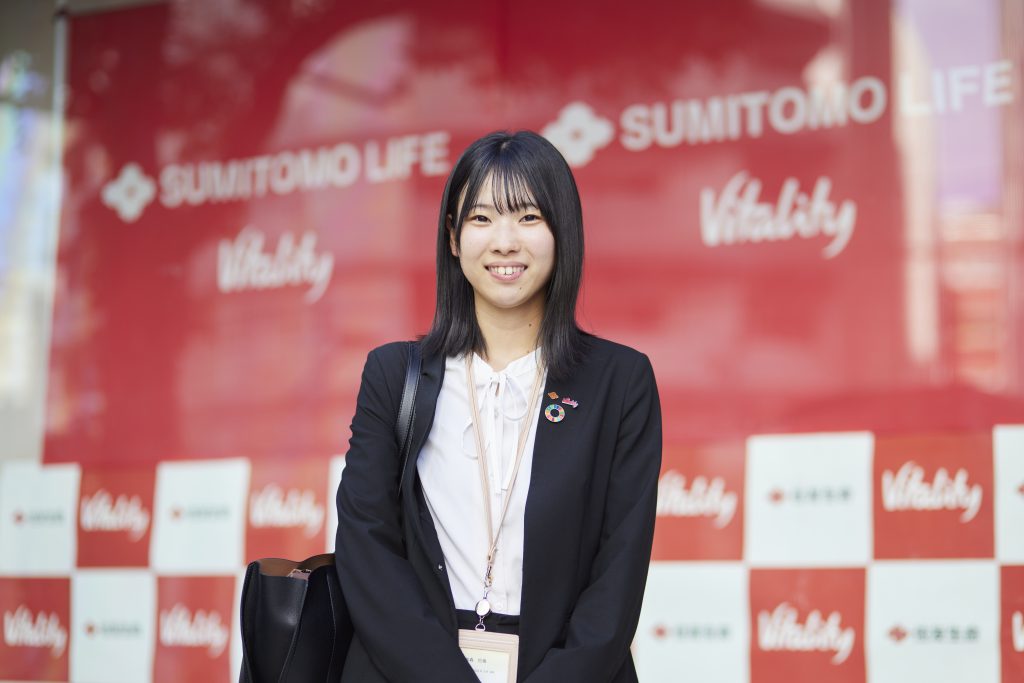
Students at Eikei University of Hiroshima, which opened in April 2021 in Naka Ward, Hiroshima City, aim to acquire five competencies—Global Collaboration, Foresight, Strategy, Energetic Drive, and Self-Improvement—by the time they graduate through active learning. To achieve this, Eikei University of Hiroshima incorporates active learning into all classes. Each class lasts 100 minutes instead of the typical 90, and two consecutive 100-minute sessions are the standard format. In addition, classes are generally limited to about 30 students, creating an environment that allows for ample dialogue and group discussion among students.
Students can explore a wide range of themes, one of which is “Well-Being,” a concept that resonates strongly with many of them. Well-being refers to a way of living that is fulfilled not only in terms of physical health but also mental happiness and overall quality of life. In recent years, this concept has attracted attention in business and management, with research showing that well-being positively impacts productivity and creativity at work. Faculty members at Eikei University emphasize that “the path to well-being is opened through dialogue and co-creation with diverse people.”
Among the first cohort of graduates in March 2025, we spoke with KAKUMORI Tomomi, who entered the insurance industry with the concept of well-being in mind, about the communication skills—Spiral diagram of deep cultivation and co-creation—that she honed over her four years at Eikei University of Hiroshima.

Eikei University of Hiroshima Expanded My World
—You are currently working as a sales representative at Sumitomo Life Insurance Company’s Hiroshima Sumirei Sales Center. Why did you choose the insurance industry?
When I entered university, I often heard the term Well-Being from my professors. Well-Being refers to a state of being fulfilled physically, mentally, and socially. The more I learned about it, the more I realized it is an essential concept for living a rich and balanced life. I thought the insurance business could contribute to that. I have always enjoyed interacting with people, so I had a vague idea from the beginning that I wanted to work in sales.
—It seems that your natural strength—enjoying interactions with people—was refined over four years and blossomed into strong communication skills.
That may be true. At Eikei University of Hiroshima, meeting people with diverse values was a major factor. As part of the first cohort, I was surrounded by many students who were highly motivated and unique. They came from different backgrounds and had different ways of thinking. Through these interactions, my communication skills were strengthened.
Next, at Eikei University of Hiroshima, I was able to study a wide range of subjects, including liberal arts and ICT/Data Science, which increased my “toolbox.” The more tools you have, the stronger you are in communication. I was exposed to fields I had never been interested in before, such as environmental studies and IT, and found them fascinating. There are so many areas that are interesting once you learn about them.
—Your senior colleagues mentioned that you were “the fastest among your peers to close a contract with a client and have a wide range of hobbies and topics.” Is what you talk about also important in communication?
I think so. The clients I meet in my work vary greatly in age, industry, and interests. That’s why having a wide range of topics is a strength. In my case, I can talk about anime, baseball, soccer—almost any topic and make it engaging.
I believe my proactive curiosity to learn about unfamiliar fields was greatly nurtured during my student years. Eikei University of Hiroshima broadened my perspective. It might be fair to say it expanded my world.

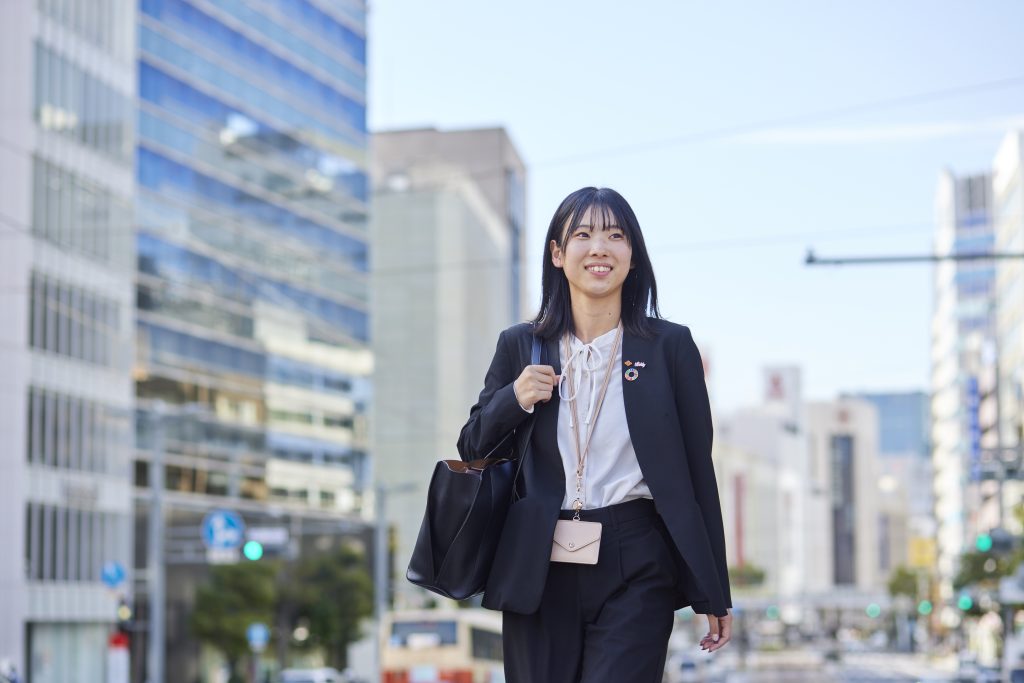
Meeting Peers Who Shape the Future
—You mentioned that many students were highly motivated and eager to take on challenges. Did you take on any challenges at Eikei University of Hiroshima?
I worked on what we called the “Business Card Project.” At Eikei University of Hiroshima, there are many opportunities to interact with people outside the university. I thought it was inconvenient not to have business cards, so I came up with the idea. I initiated the project, involved my friends, and created business cards for the entire first-year cohort.
Eikei University of Hiroshima is a place where, if a student raises their hand and says, “I want to try this,” the university encourages them to go for it. It’s also easy to find peers who will join you in taking action to make a change—that’s something unique to Eikei University of Hiroshima. Everyone is active and constantly trying new things, so the environment naturally makes you more proactive.
—All classes are based on active learning, so students take the lead, right?
Exactly. One class I remember well was Project-Based Learning (PBL). We explored how to promote the appeal of local companies with excellent technical capabilities, such as mold manufacturing, to a wider audience. We organized a workshop that involved not only students but also local residents. Through this experience—where we students took the lead in sharing ideas and deciding what to do—I developed a sense of initiative. I also learned the importance of listening carefully to others’ opinions, finding common ground, and working collaboratively. In other words, through dialogue and co-creation, I was able to learn in a way that strengthened my communication skills.
Another attractive aspect was the close relationship with faculty members. For my Degree Project, which was the culmination of four years, I could consult not only with my supervising professor but also with any professor whose expertise matched what I wanted to learn. Being able to talk to every professor is a major advantage of a small university like Eikei University of Hiroshima.
—Do you think the concept of Well-Being, which you encountered at the university, will remain an important theme for you in the future?
Yes. Hiroshima is actually gaining attention as a city that promotes Well-Being. In this city, I want to continue valuing the attitude I developed at university—being curious about everything and willing to try anything—while supporting the health and lives of as many clients as possible.
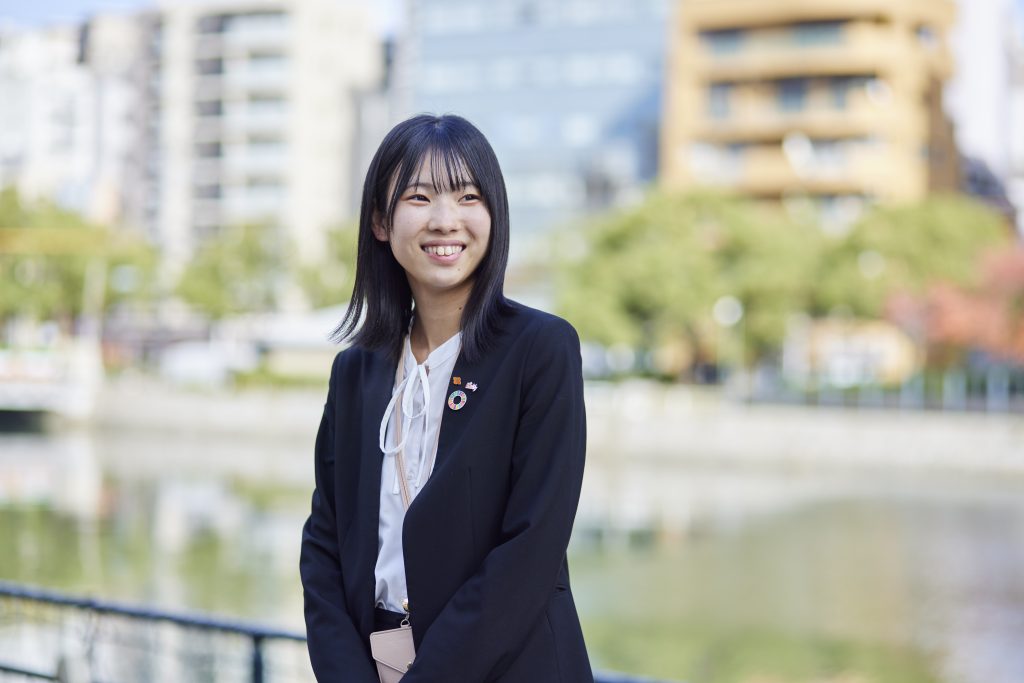
■Comment from a Supervisor at Sumitomo Life Insurance Co., Ltd.
Ms. ISHIMURA
Ms. KAKUMORI is making every effort to communicate the importance of insurance to people of all ages and backgrounds. She works collaboratively with her peers to achieve goals and approaches her tasks with dedication.
She has a strong spirit of challenge and responds positively to any assignment with “I’ll give it a try!” I believe this proactive attitude—starting by taking action—was cultivated during her time at Eikei University of Hiroshima.